
ГДЗ по английскому языку 10 класс Афанасьева Spotlight Базовый уровень страница - 23

Авторы: О. В. Афанасьева, Д. Дули, И. В. Михеева, Б. Оби, В. Эванс
Серия: Spotlight
Тип книги: Учебник
Год: 2015-2024


 Премиум


 ИИ-решебник / страница / 23
Ответ подготовлен нейросетью и может содержать ошибки
Объяснение и пошаговое решение
### Итоговые ответы
#### Exercise 1
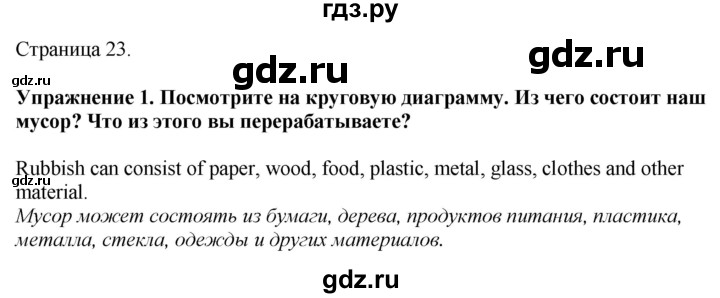
* **What makes up our rubbish?**
Our rubbish is made up of: Paper (27%), Other (20%), Wood (16%), Food (15%), Plastic (10%), Metal (7%), Glass (3%), Clothes (2%).
* **Which of these do you recycle?**
*Sample answer:* I usually recycle paper, plastic bottles, glass jars, and metal cans.
---
#### Exercise 2
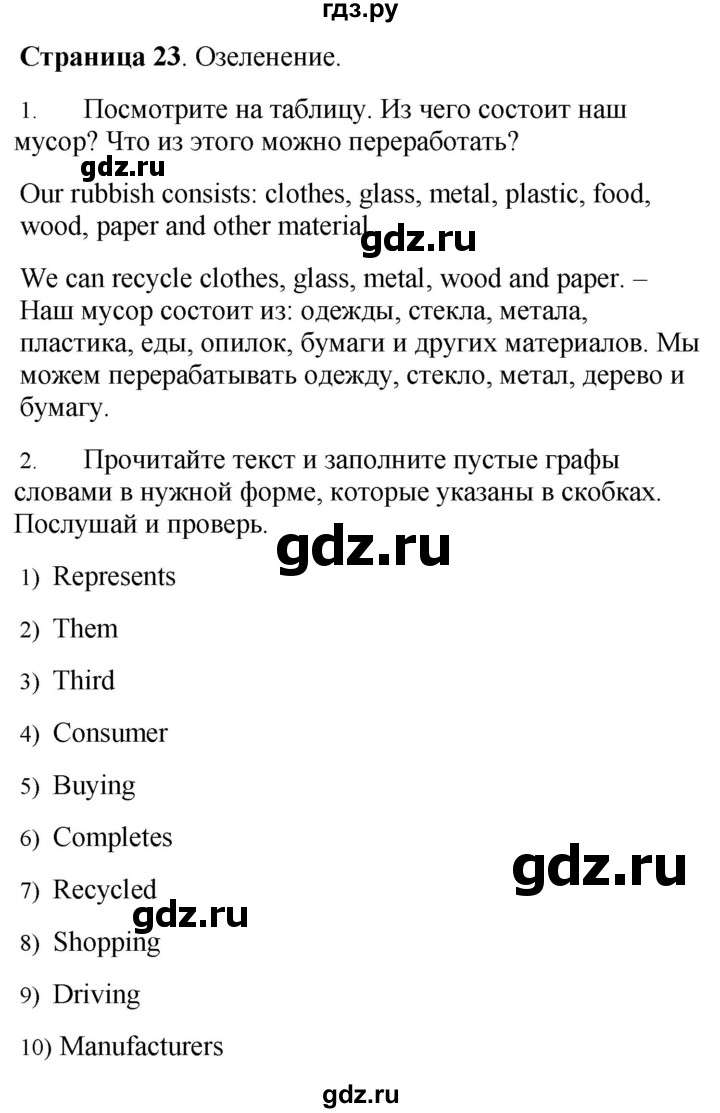
1. **representation**
2. **sorting**
3. **consumer**
4. **recycled**
5. **conservation**
6. **driving**
7. **manufacturers**
---
#### Exercise 3 (Vocabulary)
* **chasing arrows** — three curved arrows following each other in a triangle, forming the universal recycling symbol. *(стрелки, следующие друг за другом / символ переработки)*
* **recycling loop** — the continuous cycle of collecting, processing, and buying recycled products. *(замкнутый цикл переработки)*
* **facilities** — buildings, equipment, or places provided for a particular purpose (e.g., sorting rubbish). *(предприятия, комплексы)*
* **manufactured** — produced or made on a large scale using machinery. *(произведенный, изготовленный)*
* **display** — to show or make something clearly visible. *(показывать, демонстрировать)*
* **precious resources** — valuable natural materials (such as water, minerals, forests). *(ценные ресурсы)*
* **eliminate** — to completely remove or get rid of something. *(устранять, ликвидировать)*
* **landfills** — large designated areas where waste is disposed of by burying it. *(мусорные полигоны, свалки)*
---
#### Exercise 4 (Portfolio: 2-minute talk)
> "Hello everyone! Today I’d like to talk about the importance of recycling. Have you ever noticed the recycling logo with three chasing arrows? It’s not just a picture — it represents the three stages of the recycling loop.
>
> The process begins when we separate our rubbish into bins. Special trucks collect these materials and take them to recycling facilities where they are sorted. Next, factories turn these waste materials into brand-new items.
>
> However, recycling is only effective if we complete the final step: buying products made from recycled materials. By choosing clothes, accessories, and everyday goods made of recycled plastic or paper, we reduce waste in landfills and conserve our planet's precious natural resources. Remember, as consumers, we are the driving force! Let’s make responsible choices and protect our environment."
---
#### Exercise 5
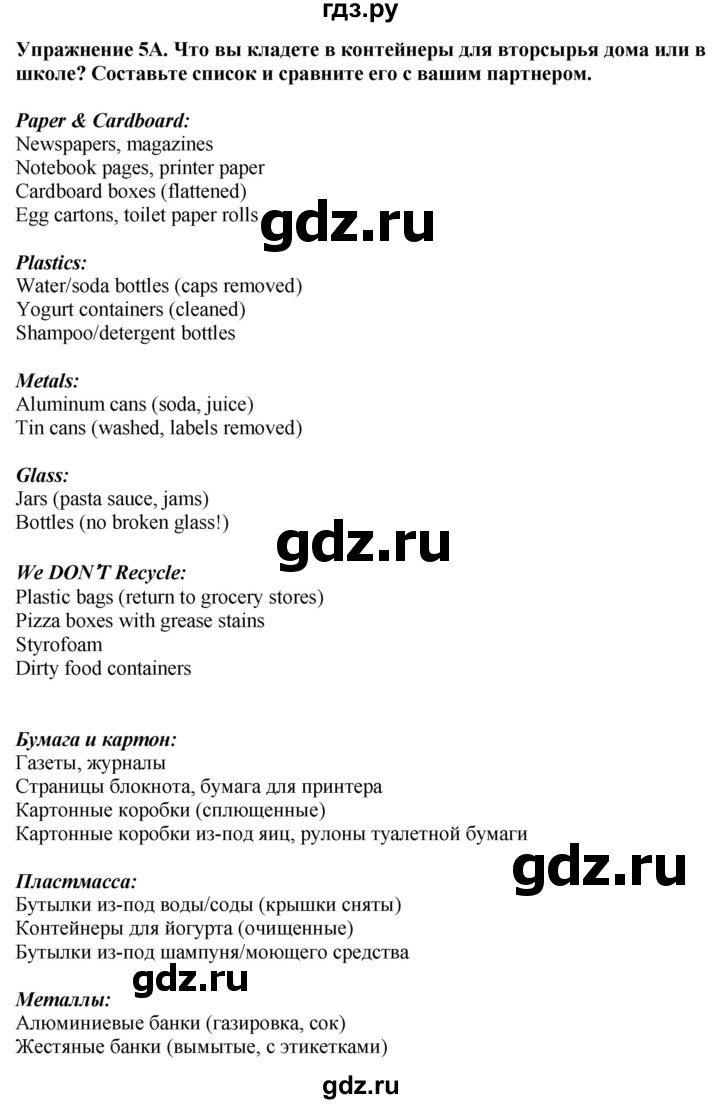
**a. What do you put in your recycling bins at home or at school?**
* **At home:** plastic bottles, empty milk cartons, newspapers, cardboard boxes, glass jars, aluminium cans.
* **At school:** used notebook pages, paper sheets, cardboard, plastic water bottles.
**b. ICT: Recycling facts presentation**
* **Paper:** can be recycled 5 to 7 times before the fibers become too short.
* **Aluminium cans:** can be recycled indefinitely without losing quality; recycling one can saves enough energy to run a TV for 3 hours.
* **Plastic:** recycled plastic bottles can be turned into fleece jackets, carpets, or new containers.
---
#### GREEN wisdom
* **Цитата:** *«In the end, we will conserve only what we love, we will love only what we understand, and we will understand only what we are taught.»* — Baba Dioum
* **Смысл:** Мы бережем и защищаем только то, что любим и ценим, а полюбить окружающую среду мы сможем лишь тогда, когда поймем, как она устроена и насколько она хрупка. Поэтому экологическое образование играет ключевую роль.
---
### Подробное объяснение к Exercise 2 (Словообразование)
1. **represent $\rightarrow$ representation**: Перед пропуском стоит неопределенный артикль `a`, за ним идет предлог `of`. Требуется существительное (*a representation of* — «представление / символ чего-либо»).
2. **sot (sort) $\rightarrow$ sorting**: Предлог `for` требует после себя герундия (отглагольного существительного) с суффиксом `-ing` (*for sorting* — «для сортировки»).
3. **consume $\rightarrow$ consumer**: По смыслу текста на третьем этапе в процесс вступает человек — «потребитель». Образуем существительное, обозначающее деятеля, с помощью суффикса `-er` (*the consumer comes in*).
4. **recycle $\rightarrow$ recycled**: Перед существительным `plastic` требуется причастие/прилагательное, отвечающее на вопрос «какой?». Образуем форму Participle II с помощью окончания `-ed` (*recycled plastic* — «переработанный пластик»).
5. **conserve $\rightarrow$ conservation**: Определенный артикль `the` и предлог `of` указывают на необходимость существительного (*the conservation of resources* — «сохранение ресурсов»).
6. **drive $\rightarrow$ driving**: В устойчивом сочетании «движущая сила» (*driving force*) используется причастие I с суффиксом `-ing`.
7. **manufacture $\rightarrow$ manufacturers**: Глагол `persuade` требует дополнения, обозначающего объект убеждения (людей/компании). Образуем существительное во множественном числе (*manufacturers* — «производители»).
Оцени решение:
Спасибо за оценку!