


ГДЗ по английскому языку 10 класс Афанасьева Spotlight Базовый уровень страница - 32

Авторы: О. В. Афанасьева, Д. Дули, И. В. Михеева, Б. Оби, В. Эванс
Серия: Spotlight
Тип книги: Учебник
Год: 2015-2024


 Премиум

### Итоговый ответ
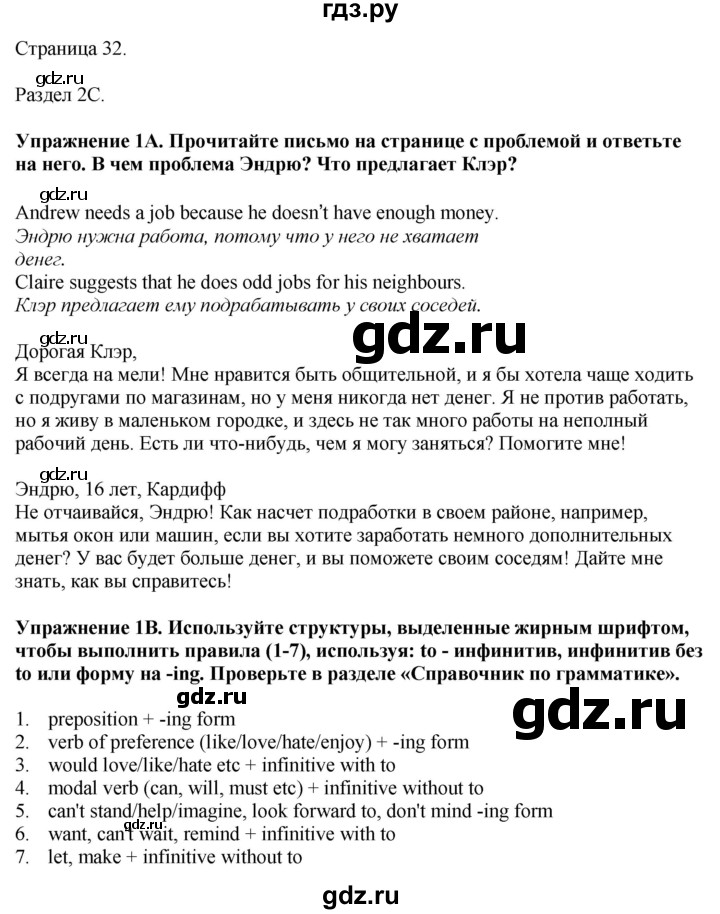
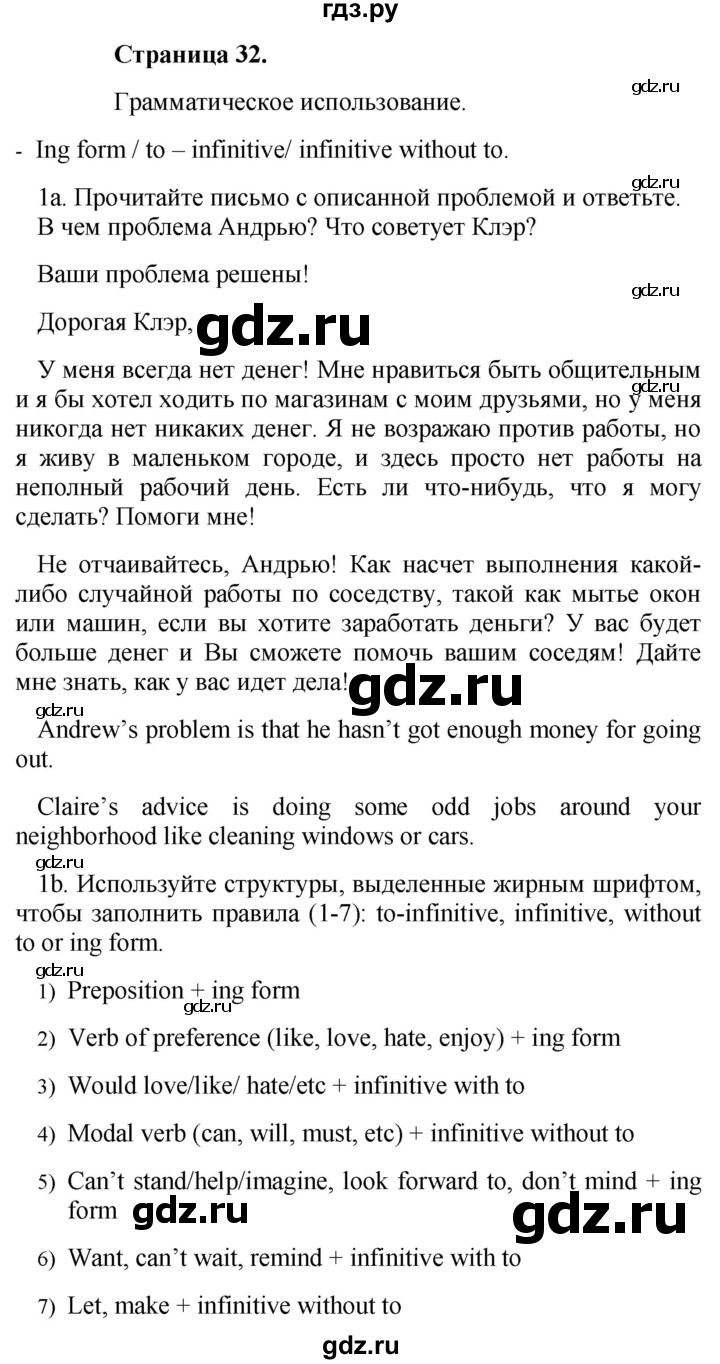
#### 1 a. Answers to the questions
* **Andrew’s problem:** He is always broke (has no money) and wants to go out shopping with his friends, but he cannot find a part-time job in his small town.
* **Claire’s suggestion:** She suggests doing odd jobs around his neighbourhood (such as cleaning windows or washing cars) to earn some extra cash.
---
#### 1 b. Grammar rules
1. preposition + **-ing form**
2. verb of preference (*like/love/hate/enjoy*) + **-ing form**
3. *would love/like/hate* etc + **to-infinitive**
4. modal verb (*can, will, must* etc) + **infinitive without to**
5. *can't stand/help/imagine, look forward to, don't mind* + **-ing form**
6. *want, can't wait, remind* + **to-infinitive**
7. *let, make* + **infinitive without to**
---
#### 2. Put the verbs in brackets into the correct form
1. Do you mind **helping** me with some jobs today, Sam? *(уже дано в образце)*
2. I'm not keen on **reading** novels. I prefer **watching** TV.
3. I must **finish** this essay tonight. I have to hand it in tomorrow!
4. He left without **saying** goodbye.
5. I'd hate **to do** archery.
6. Brian really enjoys **playing** his guitar.
7. Please let me **go** out tonight!
8. The story made me **cry**.
9. Remind me **to see** to it tomorrow.
10. Would you like **to go** now?
---
#### 3. Complete the sentences
1. She never travels by ship. She **hates sailing**.
2. He always works overtime. He **wants to work long hours** *(или: **likes working long hours**)*.
3. Mary is afraid of large groups. She **likes / enjoys being alone**.
4. Bob is never late. He **likes being on time**.
5. You decide! I **don't mind eating Chinese or Indian food**.
---
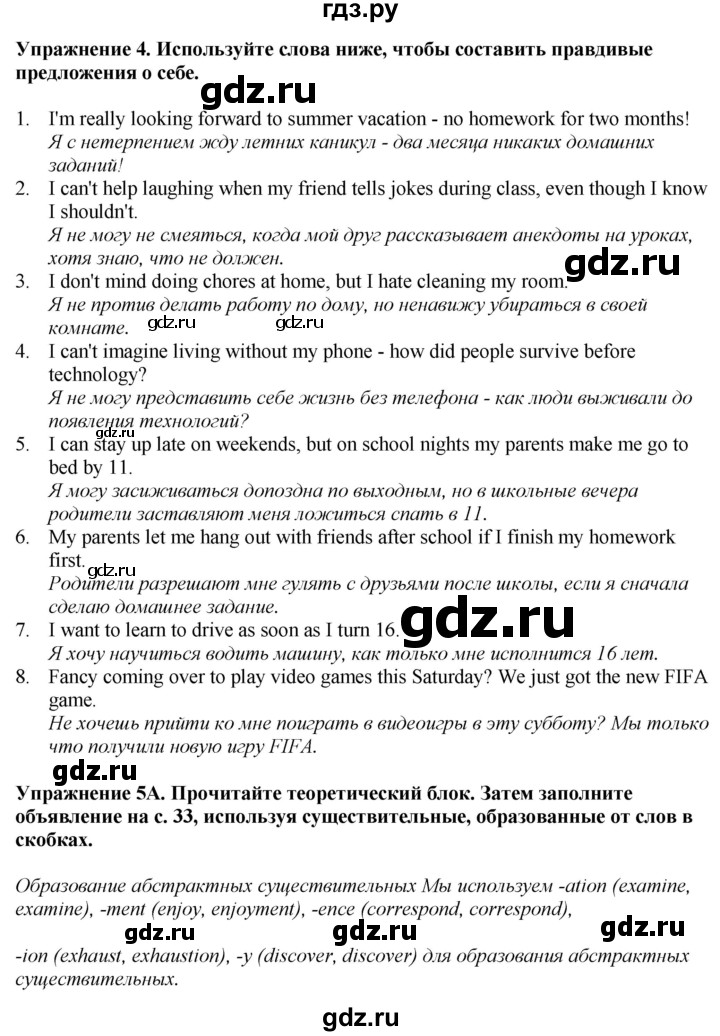
#### 4. Make true sentences about yourself (Sample answers)
* **look forward to:** I am **looking forward to travelling** abroad this summer.
* **can't help:** I **can't help laughing** when I watch that comedy show.
* **don't mind:** I **don't mind helping** my parents around the house.
* **can't imagine:** I **can't imagine living** without my smartphone.
* **can:** I **can speak** two foreign languages.
* **let:** My parents **let me stay** up late at weekends.
* **want:** I **want to enter** university after school.
* **Fancy:** Do you **fancy going** to the cinema tonight?
---
#### 5 a. Word formation (Advert)
1. **Action**
2. **competition**
3. **excitement**
4. **selection**
5. **accommodation**
---
#### 5 b. Nouns and sample sentences
1. **amaze** $\rightarrow$ **amazement** — *John looked at Tim in amazement.*
2. **educate** $\rightarrow$ **education** — *Higher education is very important for a successful career.*
3. **collect** $\rightarrow$ **collection** — *My brother has an impressive collection of coins.*
4. **depend** $\rightarrow$ **dependence** — *The country is trying to reduce its dependence on oil.*
5. **achieve** $\rightarrow$ **achievement** — *Winning the competition was a great achievement for our team.*
6. **suggest** $\rightarrow$ **suggestion** — *Thank you for your helpful suggestion.*
7. **recover** $\rightarrow$ **recovery** — *We all wish you a speedy recovery.*
8. **agree** $\rightarrow$ **agreement** — *They finally signed a trade agreement.*
---
### Подробное объяснение и правила
#### Задания 1a, 1b и 2: Герундий (*-ing form*), инфинитив с частицей *to* и голый инфинитив (*bare infinitive*)
1. **-ing form (герундий)** используется:
* после предлогов (*on, without, about, in* и др.) $\rightarrow$ *keen on reading*, *without saying*;
* после глаголов предпочтения (*like, love, enjoy, hate, prefer*), когда речь идет об общем отношении $\rightarrow$ *enjoys playing*, *prefer watching*;
* после устойчивых выражений: *don't mind, can't stand, can't help, look forward to, can't imagine, fancy*.
2. **to-infinitive (инфинитив с to)** используется:
* после конструкций с *would* (*would like, would love, would hate, would prefer*);
* после глаголов волеизъявления и намерения: *want, decide, hope, can't wait, remind, agree*.
3. **Infinitive without to (голый инфинитив)** используется:
* после модальных глаголов (*can, must, should, will, might* и др.) $\rightarrow$ *must finish*;
* после глаголов *let* (позволять) и *make* (заставлять) в активном залоге $\rightarrow$ *let me go*, *made me cry*.
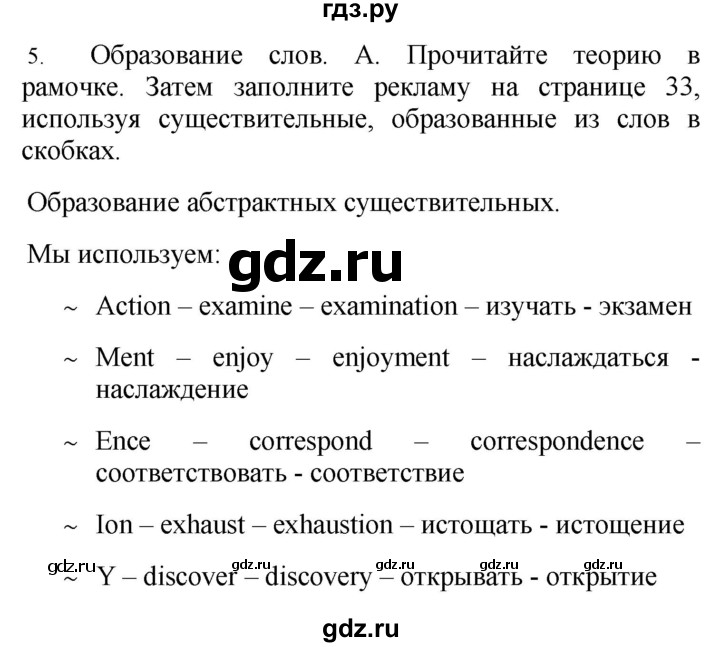
#### Задание 5: Словообразование (Образование абстрактных существительных)
Абстрактные существительные образуются от глаголов с помощью суффиксов:
* **-ion / -ation / -ition:** *act $\rightarrow$ action*, *compete $\rightarrow$ competition*, *select $\rightarrow$ selection*, *educate $\rightarrow$ education*, *collect $\rightarrow$ collection*, *suggest $\rightarrow$ suggestion*;
* **-ment:** *excite $\rightarrow$ excitement*, *accommodate $\rightarrow$ accommodation* (в 5a) / *achieve $\rightarrow$ achievement*, *agree $\rightarrow$ agreement*;
* **-ence:** *depend $\rightarrow$ dependence*;
* **-y:** *recover $\rightarrow$ recovery*.
Спасибо за оценку!







Открой больше возможностей
Войди через VK — задавай вопросы ИИ и сохраняй ГДЗ в избранное
