


ГДЗ по английскому языку 10 класс Афанасьева Spotlight Базовый уровень страница - 173

Авторы: О. В. Афанасьева, Д. Дули, И. В. Михеева, Б. Оби, В. Эванс
Серия: Spotlight
Тип книги: Учебник
Год: 2015-2024


 Премиум

### Итоговые ответы
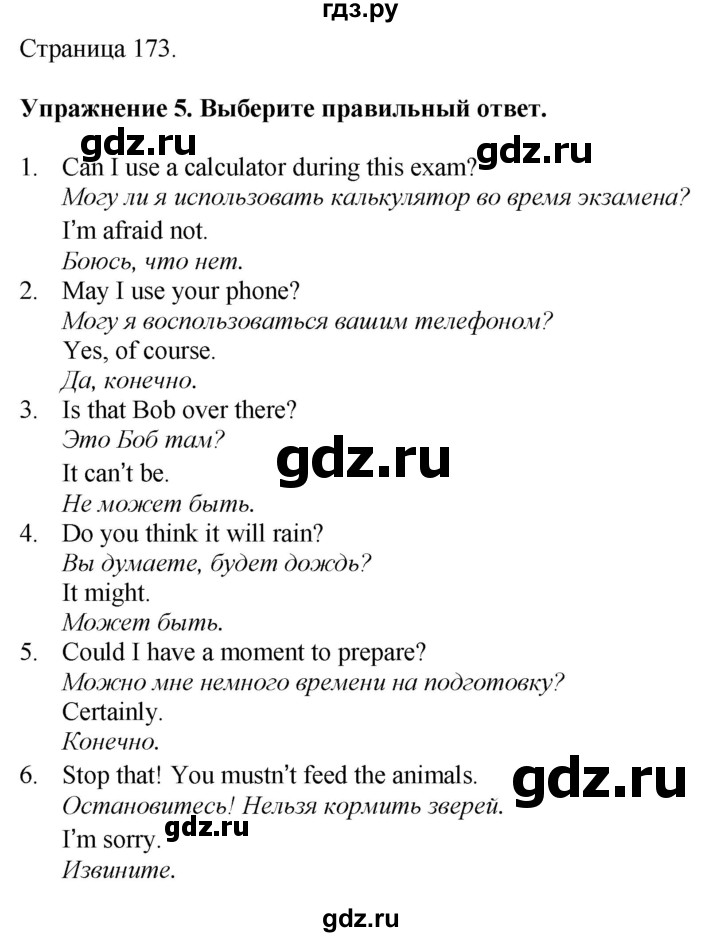
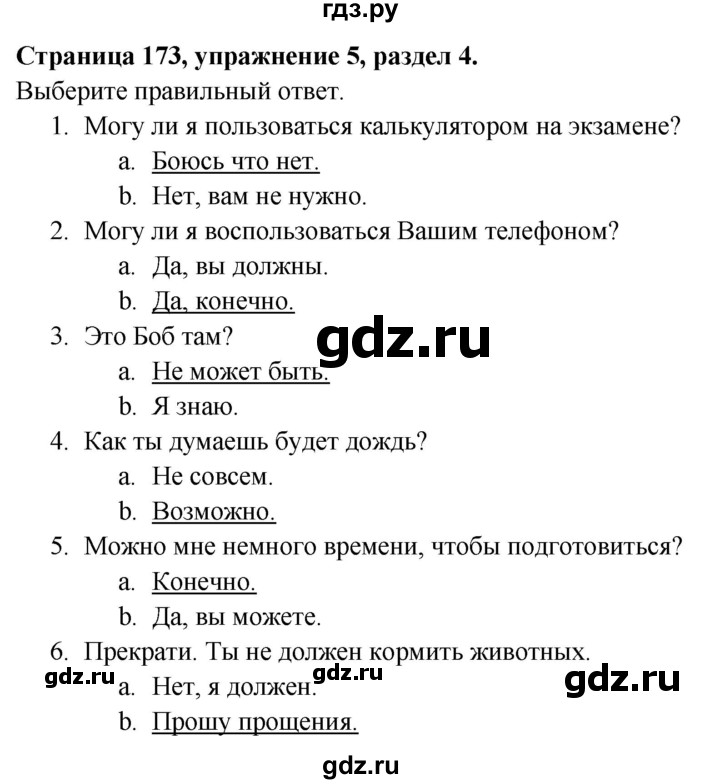
#### Exercise 5. Choose the correct answer
1. **A** (I'm afraid not.)
2. **B** (Yes, of course.)
3. **A** (It can't be.)
4. **B** (It might.)
5. **A** (Certainly.)
6. **B** (I'm sorry.)
---
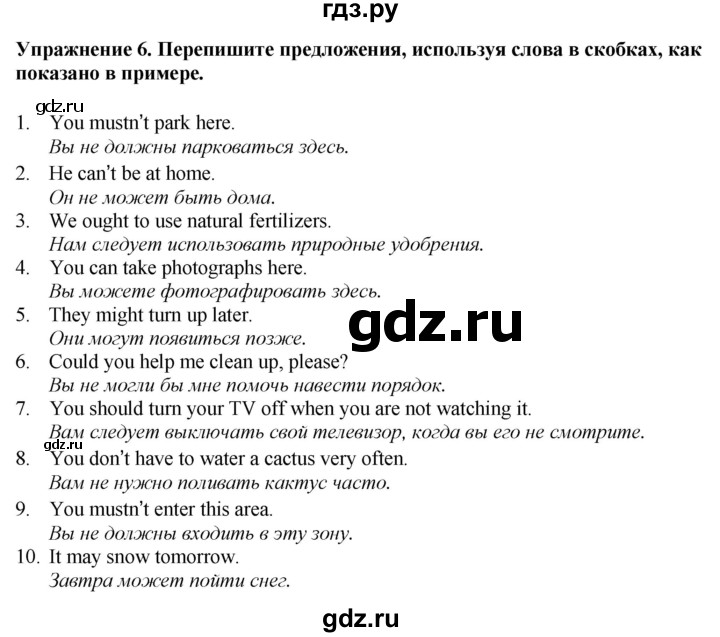
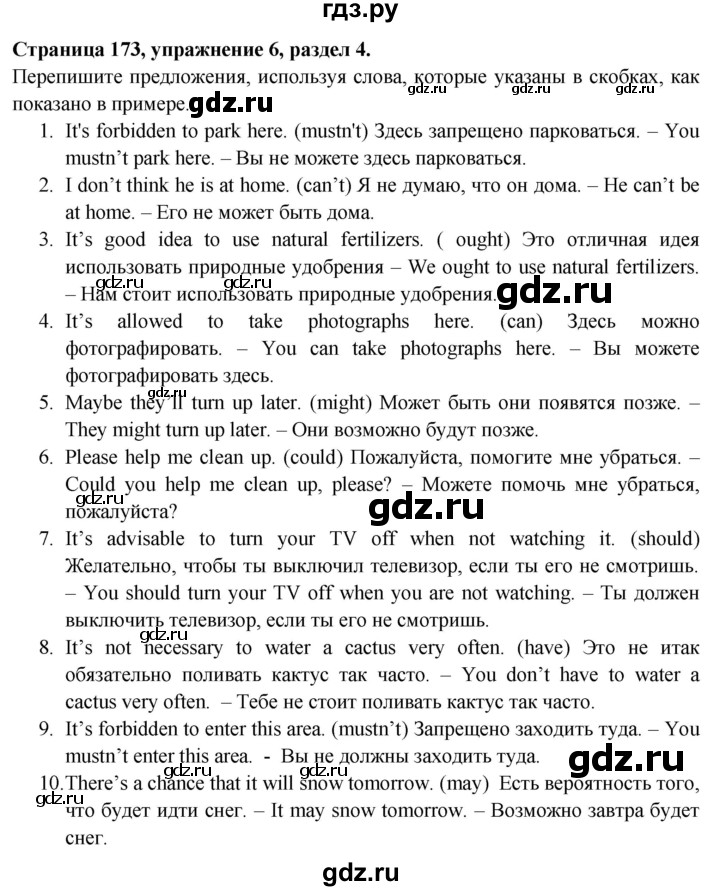
#### Exercise 6. Rewrite the sentences using the words in brackets
1. You mustn't park here. *(пример)*
2. He **can't be at home**.
3. You **ought to use natural fertilizers**.
4. You **can take photographs here**.
5. They **might turn up later**.
6. **Could you help me clean up?**
7. You **should turn your TV off when not watching it**.
8. You **don't have to water a cactus very often**.
9. You **mustn't enter this area**.
10. It **may snow tomorrow**.
---
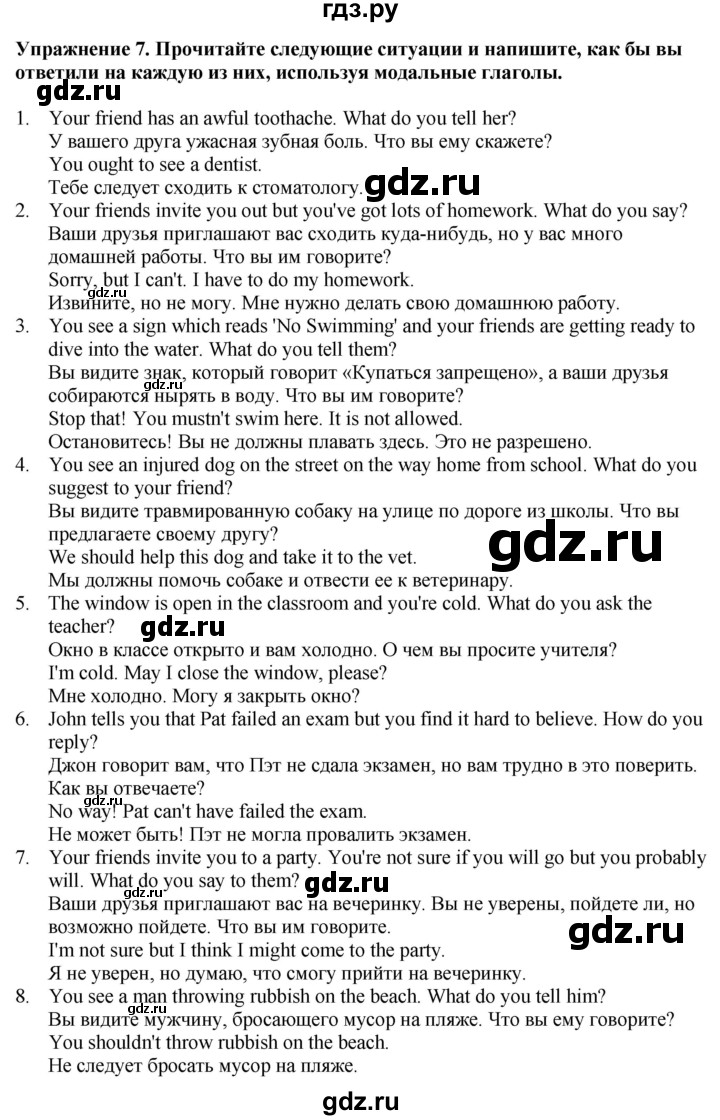
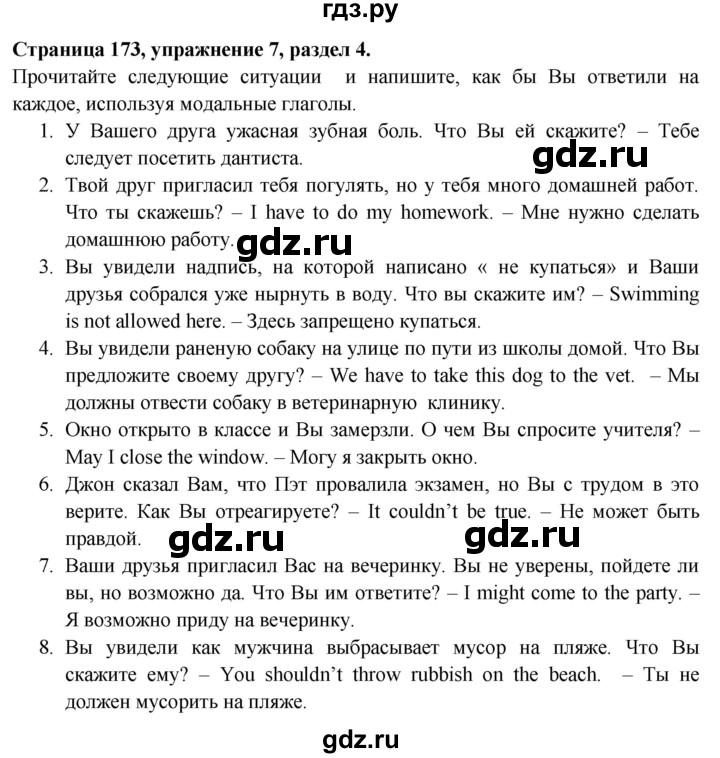
#### Exercise 7. Respond to each situation using modals *(примерные варианты ответов)*
1. *"You ought to see a dentist."* *(пример)*
2. *"I can't go out because I have to do my homework."*
3. *"You mustn't dive into the water here. It's forbidden."*
4. *"We should take it to the vet."*
5. *"Could I close the window, please?"*
6. *"That can't be true! She's such a good student."*
7. *"I might come, but I'm not completely sure."*
8. *"You shouldn't throw rubbish on the beach."*
---
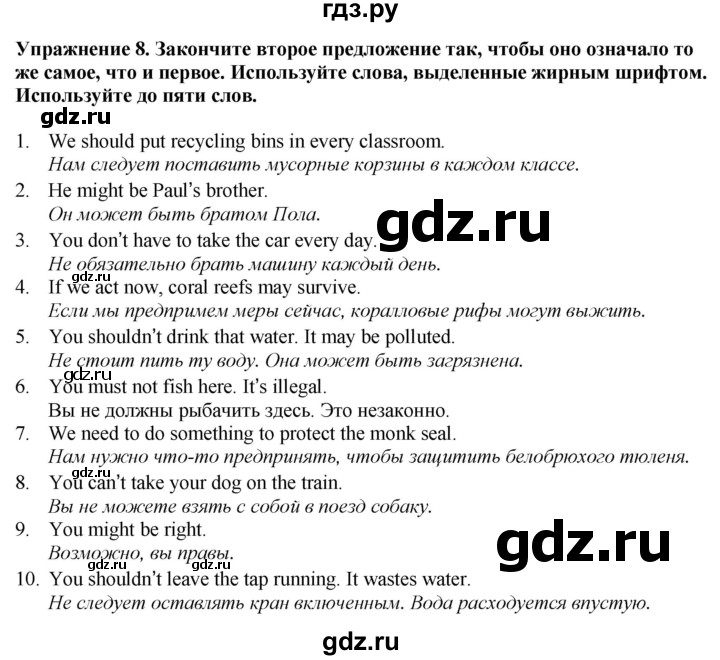
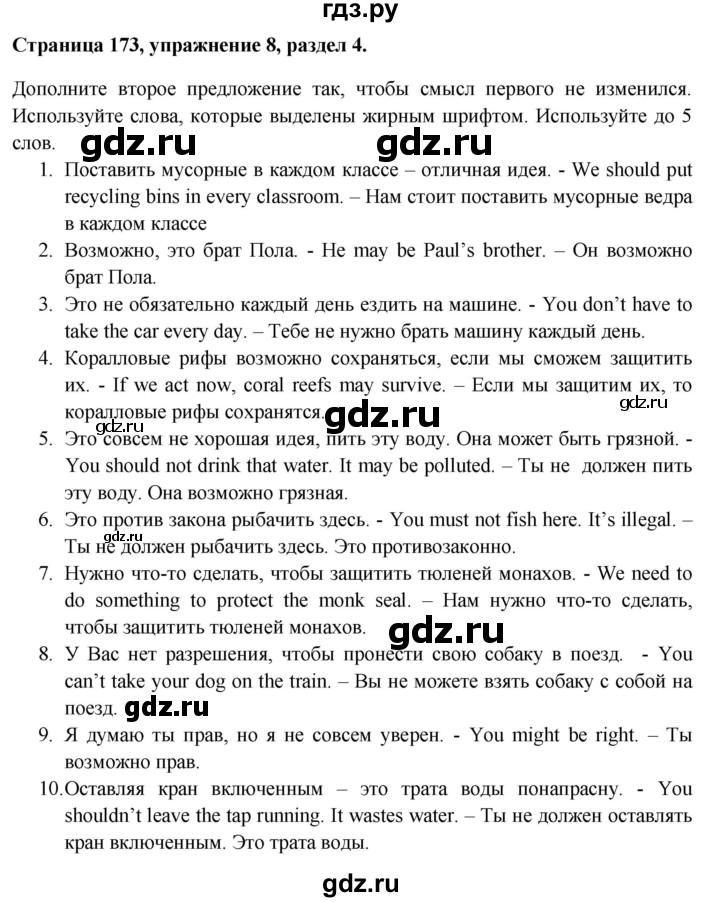
#### Exercise 8. Complete the second sentence (from 2 to 5 words)
1. We **should put recycling bins** in every classroom.
2. He **might / may / could be Paul's** brother.
3. You **don't have to take** the car every day.
4. If we act now, **coral reefs may survive**.
5. You **shouldn't / should not drink that water**. It may be polluted.
6. You **must not / mustn't fish here**. It's illegal.
7. We **need to do something to** protect the monk seal.
8. You **can't take your dog** on the train.
9. You **may / might / could be** right.
10. You **should not / shouldn't leave the tap** running. It wastes water.
---
### Подробное объяснение
#### Exercise 5
* **1 — A**: Вопрос *Can I...?* выражает просьбу о разрешении. Вежливый отказ формулируется фразой *I'm afraid not* («Боюсь, что нет»). Вариант *needn't* выражает отсутствие необходимости, что здесь не подходит по смыслу.
* **2 — B**: На вежливую просьбу *May I...?* утвердительным ответом служит *Yes, of course* («Да, конечно»). Глагол *must* выражает строгое обязательство, а не согласие.
* **3 — A**: Модальный глагол *can't* используется для выражения логической невозможности (*It can't be* — «Не может быть»).
* **4 — B**: Глагол *might* выражает вероятностное предположение о будущем событии («Возможно / может пойти»).
* **5 — A**: *Certainly* («Конечно / безусловно») — стандартный вежливый ответ на просьбу (*Could I...?*).
* **6 — B**: В ответ на замечание о запрете (*mustn't*) естественно принести извинения (*I'm sorry*).
#### Exercise 6
* **2**: *I don't think he is...* заменяется конструкцией логического отрицания: **can't + be** (он не может быть...).
* **3**: *It's a good idea to...* (хорошая идея) выражается советом через **ought to** (+ начальная форма глагола).
* **4**: *You are allowed to...* (вам разрешено) выражается разрешением через **can**.
* **5**: *Maybe...* (возможно) передаётся модальным глаголом слабой вероятности **might**.
* **6**: *Please help me...* перефразируется в вежливую просьбу с глаголом **Could**: *Could you help me...?*
* **7**: *It's advisable to...* (рекомендуется) заменяется на совет через **should**.
* **8**: *It's not necessary to...* (нет необходимости) заменяется на **don't have to**.
* **9**: *It's forbidden to...* (запрещено) заменяется на строгий запрет **mustn't**.
* **10**: *There's a chance that...* (есть шанс) выражается через глагол вероятности **may**.
#### Exercise 7
* **2**: Используем **can't** (невозможность пойти) и **have to / must** (необходимость делать уроки).
* **3**: Используем **mustn't** (строгий запрет согласно знаку).
* **4**: Используем **should / ought to / shall** для внесения предложения или совета помочь животному.
* **5**: Используем вежливые формы запроса разрешения **Could I / May I**.
* **6**: Используем **can't** для выражения сомнения и невероятности факта (*That can't be true*).
* **7**: Используем **might / may** для выражения вероятного действия.
* **8**: Используем **shouldn't / mustn't** для выражения порицания или запрета нарушать правила.
#### Exercise 8
* **1**: *would be a good idea* $\rightarrow$ совет **should** + глагол **put recycling bins**.
* **2**: *It's possible that he's...* $\rightarrow$ предположение с глаголом **be**: **might / may / could be Paul's**.
* **3**: *It isn't necessary to take* $\rightarrow$ отсутствие необходимости **don't have to take**.
* **4**: *will probably survive* $\rightarrow$ **coral reefs may survive**.
* **5**: *It's not a good idea to drink* $\rightarrow$ отрицательный совет **shouldn't / should not drink that water**.
* **6**: *against the law* $\rightarrow$ запрет по закону **must not / mustn't fish here**.
* **7**: *Something must be done to...* $\rightarrow$ активный залог с глаголом **need**: **need to do something to**.
* **8**: *don't have permission to take* $\rightarrow$ отсутствие разрешения **can't take your dog**.
* **9**: *I think you're right but...* $\rightarrow$ частичное согласие/вероятность **may / might / could be**.
* **10**: *Leaving the tap running wastes water* $\rightarrow$ совет не оставлять кран открытым: **should not / shouldn't leave the tap**.
Спасибо за оценку!

Открой больше возможностей
Войди через VK — задавай вопросы ИИ и сохраняй ГДЗ в избранное
